

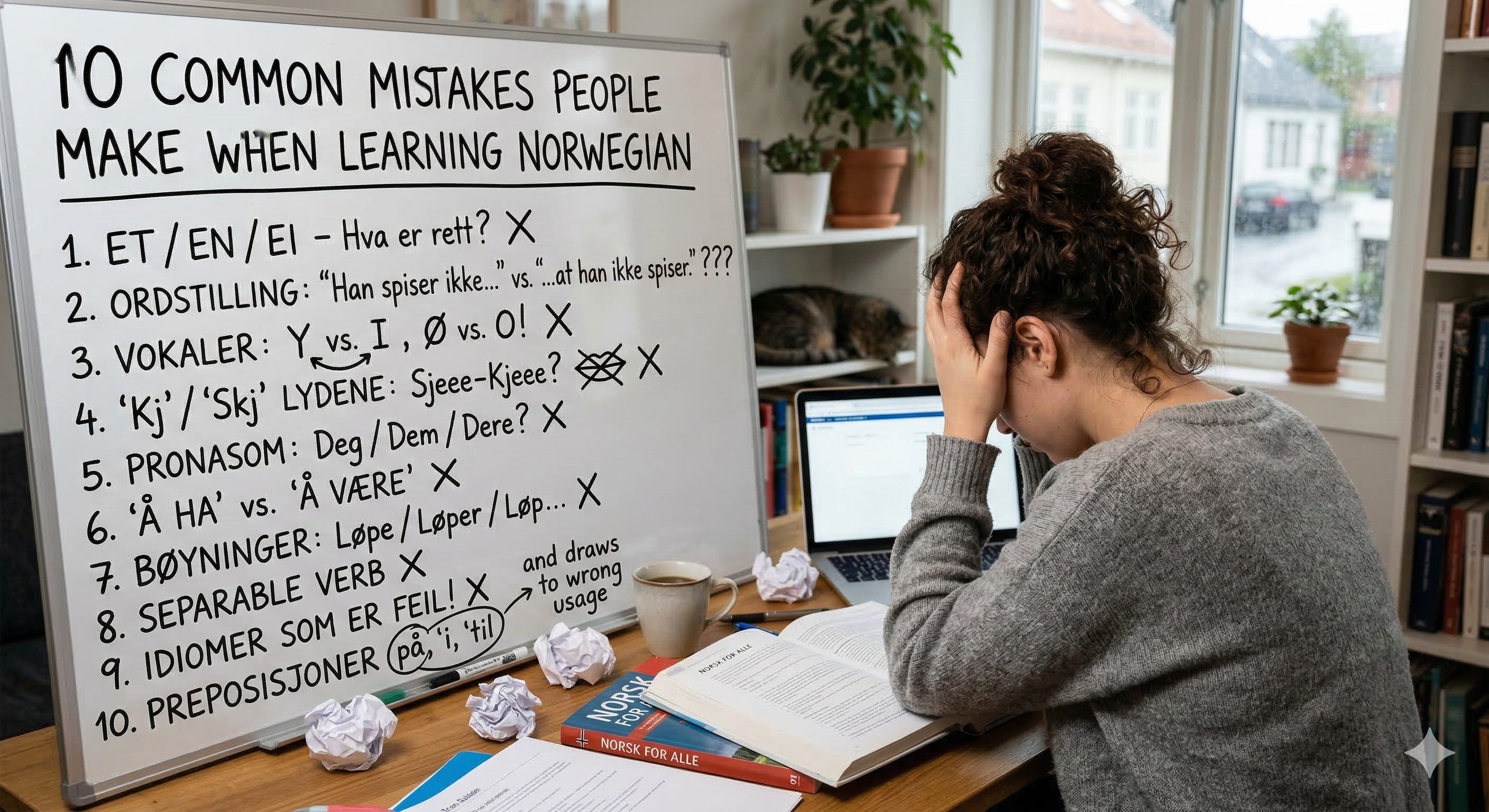
When learning a new language, mistakes are completely normal. In fact, many people who learn Norwegian make the same types of mistakes.
This usually happens because your brain is trying to apply rules from languages you already know.
Here are some common mistakes many learners make when speaking Norwegian.
1. Jeg har 30 år
This is one of the most common mistakes.
Many languages use the verb to have when talking about age. Norwegian does not.
❌ Jeg har 30 år.
(I have 30 years.)
✔ Jeg er 30 år.
(I am 30 years old.)
In Norwegian, we use å være (to be) when talking about age.
2. Mixing two structures
Sometimes learners combine two different sentence structures.
❌ Jeg har er 30 år.
(I have am 30 years.)
✔ Jeg er 30 år.
(I am 30 years old.)
This usually happens when people are thinking in another language while speaking Norwegian.
3. Trying to use a continuous form
English often uses a continuous form with to be + verb.
Learners sometimes try to do the same in Norwegian.
❌ Jeg er spiser frokost.
(I am eating breakfast.)
✔ Jeg spiser frokost.
(I eat / I am eating breakfast.)
Norwegian usually does not use a continuous form.
If you want to emphasise that something is happening right now, you can say:
✔ Jeg sitter og spiser frokost.
(I am sitting and eating breakfast.)
✔ Jeg holder på å spise frokost.
(I am in the middle of eating breakfast.)
4. Wrong gender with nouns
Norwegian nouns have grammatical gender, and this can be confusing.
❌ Jeg jobber i en firma.
(I work in a company.)
✔ Jeg jobber i et firma.
(I work in a company.)
The word firma is a neuter noun, so we use et, not en.
5. Using siden incorrectly
Learners often translate directly from English.
❌ Jeg bor her siden tre år.
(I live here since three years.)
✔ Jeg har bodd her i tre år.
(I have lived here for three years.)
When something started in the past and continues until now, Norwegian often uses har + verb.
6. Using too many words
Sometimes learners combine words that mean almost the same thing.
❌ Jeg gleder meg til å møte deg igjen tilbake.
(I look forward to meeting you again back.)
✔ Jeg gleder meg til å møte deg igjen.
(I look forward to meeting you again.)
7. Forgetting godt
Norwegian often uses godt after verbs like like.
❌ Jeg liker veldig.
(I like very.)
✔ Jeg liker det veldig godt.
(I like it very much.)
8. Wrong verb or unnatural expression
Sometimes the problem is not only the preposition, but the whole expression.
❌ Jeg går til jobb med buss.
(I walk to work with bus.)
More natural Norwegian would be:
✔ Jeg tar bussen til jobb.
(I take the bus to work.)
✔ Jeg reiser til jobb med buss.
(I travel to work by bus.)
✔ Jeg drar til jobb med buss.
(I go to work by bus.)
In Norwegian, we do not say går til jobb med buss, because å gå means to walk.
9. Using fra instead of siden
Learners often confuse these two words.
❌ Jeg har jobbet her fra 2022.
(I have worked here from 2022.)
✔ Jeg har jobbet her siden 2022.
(I have worked here since 2022.)
10. Forgetting til
Some Norwegian verbs require a specific preposition.
❌ Jeg gleder meg å se deg.
(I look forward to see you.)
✔ Jeg gleder meg til å se deg.
(I look forward to seeing you.)
Mistakes are part of learning
Everyone who learns a language makes mistakes. That is not a sign that you are doing something wrong — it is a sign that you are actually using the language.
The more you speak, write, and practise, the more natural Norwegian will start to feel.
And one day you may notice that the sentences simply come to you without thinking.
Thank you for reading
Thank you for taking the time to read this article.
If you found it helpful, please consider liking, restacking, or sharing it. That helps more people who are learning Norwegian discover the blog.
You are also very welcome to leave a comment. I always enjoy hearing about your experiences and questions when learning Norwegian.
And if you haven’t already, feel free to subscribe so you can receive new articles directly in your inbox. If you don’t want your inbox full of mail from Substack, there is a button that can prevent that, even if you subscribe to get the paid material that will soon come.
Thanks for reading!