

Norwegian Adjectives – Predicative Adjectives
In earlier articles, we looked at adjectives used before nouns:
en stor bil → a big car
et gammelt hus → an old house
In these cases, adjectives appear inside the noun phrase and describe the noun directly.
But adjectives don’t only appear before nouns.
They also appear after verbs — and when they do, they are called predicative adjectives.
What is a predicative adjective?
A predicative adjective appears after a verb and describes the subject of the sentence.
It completes the meaning of the verb rather than modifying the noun directly.
The most common verbs used with predicative adjectives are:
er (is / are)
blir (becomes)
virker (seems)
Basic examples
Let’s start with simple sentences.
Bilen er stor.
→ The car is big.
Huset er stort.
→ The house is big.
Bilene er store.
→ The cars are big.
Even though the adjective comes after the verb, it still agrees with the noun.
Agreement still applies
Predicative adjectives follow the same agreement rules as attributive adjectives — including feminine nouns.
Singular masculine
En bil → bilen er stor
→ A car → the car is big
Singular feminine
Ei bok → boka er stor
→ A book → the book is big
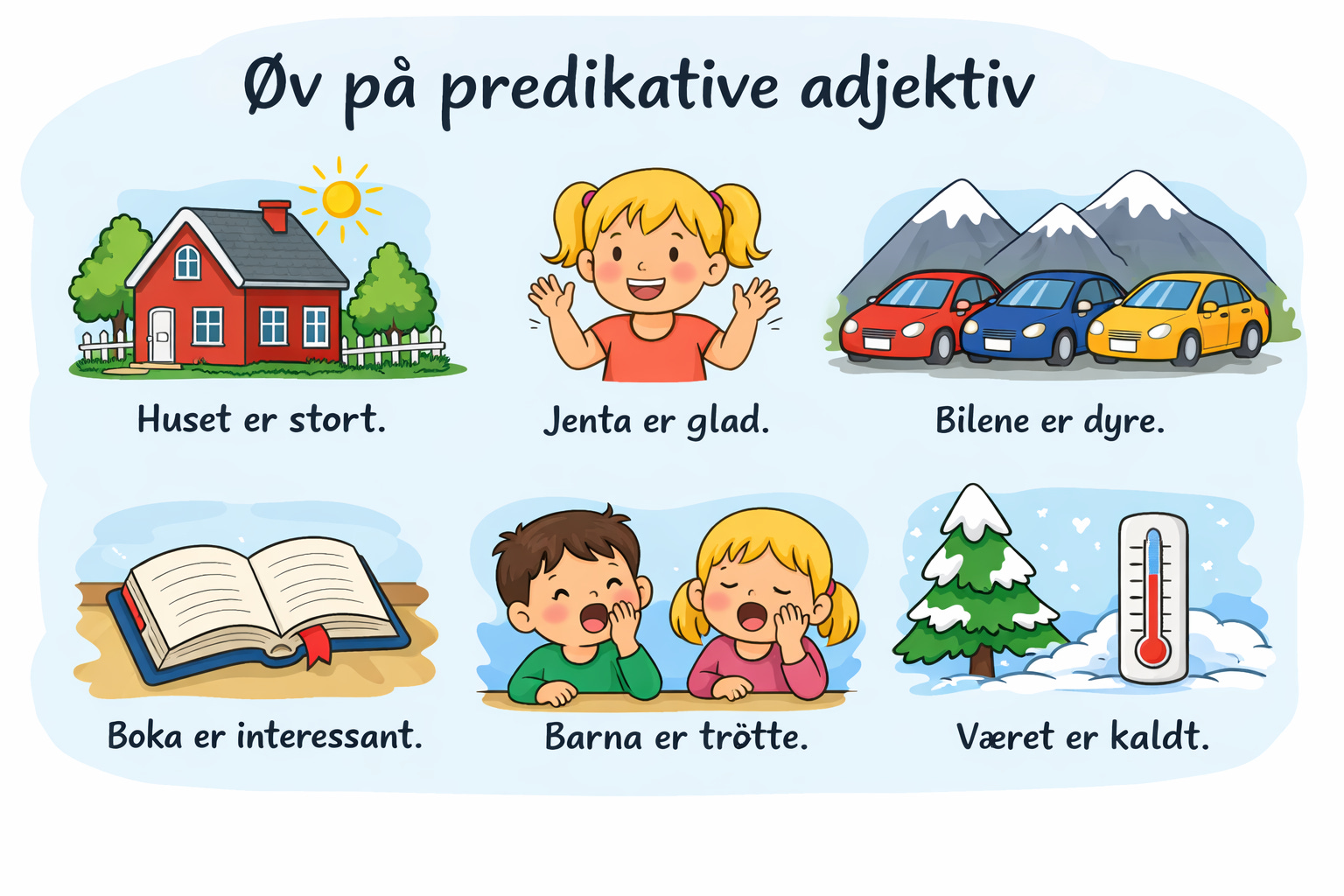
Ei jente → jenta er glad
→ A girl → the girl is happy
Notice that the adjective form is identical to masculine.
Norwegian does not distinguish between masculine and feminine in adjective agreement — only in the article and noun form.
Singular neuter
Et hus → huset er stort
→ A house → the house is big
Et barn → barnet er lite
→ A child → the child is small
Here the adjective takes the -t ending.
Plural — gender disappears
In plural, grammatical gender no longer matters.
All nouns — masculine, feminine, and neuter — use the same adjective form.
Examples
Biler → bilene er store
→ Cars → the cars are big
Bøker → bøkene er store
→ Books → the books are big
Hus → husene er store
→ Houses → the houses are big
Barn → barna er små
→ Children → the children are small
So regardless of gender in singular, plural adjectives follow the same pattern.
Other verbs with predicative adjectives
Adjectives are not limited to er.
Hun blir glad.
→ She becomes happy.
Maten virker god.
→ The food seems good.
Filmen var interessant.
→ The film was interesting.
In each sentence, the adjective describes the subject — not the action.
Attributive vs. predicative use
Let’s compare the two structures.
Attributive (before noun)
en stor bil
→ a big car
Predicative (after verb)
Bilen er stor.
→ The car is big.
Same adjective — different position — same agreement rules.
Neuter agreement in predicative position
Neuter nouns require the -t ending even after verbs.
Huset er gammelt.
→ The house is old.
Været er fint.
→ The weather is nice.
Barnet er lite.
→ The child is small.
Agreement always reflects the grammatical gender of the subject.
Plural predicative adjectives
Plural agreement is often easier to recognize.
Barna er glade.
→ The children are happy.
Bilene er dyre.
→ The cars are expensive.
Fjellene er vakre.
→ The mountains are beautiful.
Plural subjects → plural adjective form (-e).
Predicative adjectives describing states
Predicative adjectives frequently describe:
Feelings
Conditions
States
Evaluations
Examples:
Jeg er trøtt.
→ I am tired.
Hun er syk.
→ She is sick.
De er klare.
→ They are ready.
Here the adjective describes a state rather than an action.
🔑 Key takeaway
Predicative adjectives:
Appear after verbs
Describe the subject
Follow agreement rules
Include masculine, feminine, and neuter nouns
Use the same form for all genders in plural
You can summarize the system like this:
Masculine & feminine → same adjective form
Neuter → adds -t
Plural → uses -e for all genders
Understanding predicative adjectives helps learners move from simple noun phrases into real Norwegian sentence structure.
📝 Practice – Predicative Adjectives
Her er en oppdatert versjon med tydelige retningslinjer og kun ett korrekt svar per setning.
Interactive exercise: Click here!
Other exercises:
Instructions
Translate the sentences into Norwegian.
Use the adjective provided in brackets.
Make sure the adjective agrees with the subject.
1️⃣ Singular agreement
The house is big. (stor)
The girl is happy. (glad)
The child is small. (liten)
The book is interesting. (interessant)
The weather is cold. (kald)
2️⃣ Plural agreement
The cars are expensive. (dyr)
The mountains are beautiful. (vakker)
The children are happy. (glad)
The houses are old. (gammel)
The books are interesting. (interessant)
3️⃣ Mixed gender
Translate using correct agreement.
The car is big.
The house is big.
The book is big.
The cars are big.
The houses are big.
Adjective: stor
4️⃣ Verb + predicative adjective
Use the verb + adjective correctly.
She becomes happy. (bli / glad)
The food seems good. (virke / god)
The children are tired. (være / trøtt)
The film is interesting. (være / interessant)
The boy becomes sad. (bli / lei seg)
🔑 Answer Key
1️⃣ Singular
Huset er stort.
Jenta er glad.
Barnet er lite.
Boka er interessant.
Været er kaldt.
2️⃣ Plural
Bilene er dyre.
Fjellene er vakre.
Barna er glade.
Husene er gamle.
Bøkene er interessante.
3️⃣ Mixed gender
Bilen er stor.
Huset er stort.
Boka er stor.
Bilene er store.
Husene er store.
4️⃣ Verb + adjective
Hun blir glad.
Maten virker god.
Barna er trøtte.
Filmen er interessant.
Gutten blir lei seg.
If you like this post, please, feel free to like, share, restack, comment and subscribe for more.
