

In Norwegian, nouns are words for people, animals, things, places, and ideas. Every noun has a gender, and nouns are inflected for singular and plural, in indefinite and definite form.
The three genders
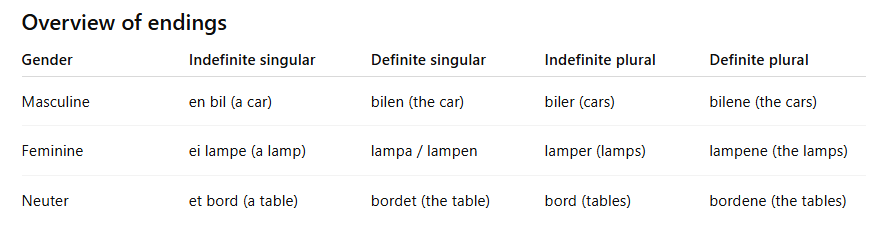
Masculine (hankjønn)
Most nouns are masculine.
The definite singular ends in -en.
Example: en stol – stolen – stoler – stolene (a chair – the chair – chairs – the chairs).
Feminine (hunkjønn)
In theory, all feminine nouns can be declined as masculine.
Definite singular usually ends in -a, but -en is also possible.
Example: ei bok – boka – bøker – bøkene (a book – the book – books – the books).
→ It is also correct to say: en bok – boken – bøker – bøkene.
Neuter (intetkjønn)
Definite singular ends in -et.
Example: et hus – huset – hus – husene (a house – the house – houses – the houses).
Irregular nouns
Some words do not follow the standard patterns:
en mann – mannen – menn – mennene (man – the man – men – the men)
ei tann – tanna – tenner – tennene (tooth – the tooth – teeth – the teeth)