

Suggested by Carlo Jose.
In Norwegian, some verbs end in –s. These are called –s verbs, and they can look confusing at first — but they are actually quite simple once you understand what they do.
The –s ending usually shows that:
The action is passive
The action happens “by itself”
Nobody is doing the action (impersonal use)
It is part of a fixed expression
The verb describes a mutual action (each other)
Let’s go through them step by step.
⭐ 1. Passive Meaning
Sometimes the –s form replaces the passive voice.
Examples:
Døren åpnes klokka 09.
The door is opened at 9.Boka selges i butikken.
The book is sold in the store.
Here the verb tells you what happens, not who does it.
⭐ 2. Actions That “Happen by Themselves”
Some verbs in –s describe actions that don’t need a doer.
Examples:
Han trives i Norge.
He enjoys living in Norway / He thrives in Norway.Det finnes mange dialekter her.
There are many dialects here.
(Literally: “It is found…”)
These verbs always end in –s. They do NOT have a form without –s.
⭐ 3. Impersonal (Nobody Is the Actor)
The subject is not a person — or doesn’t matter.
Examples:
Det sies at været blir bedre.
It is said that the weather will improve.Det vises en film i kveld.
A movie is being shown tonight.
⭐ 4. Fixed Expressions
Some –s verbs are simply set phrases, and you must learn them as they are.
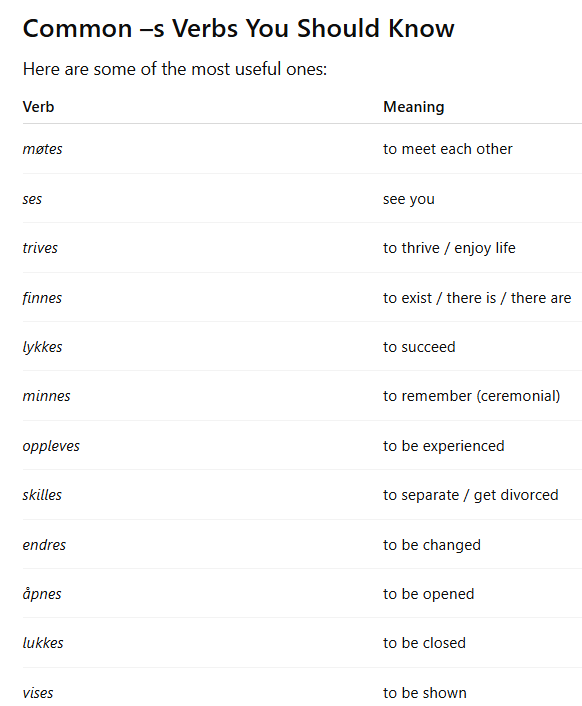
Common examples:
takkes – to be thanked
minnes – to be remembered
skiftes – to be changed (medicine, diapers, clothes, etc.)
oppleves – to be experienced / “feels like”
Example:
Julen oppleves best sammen med familie.
Christmas is best experienced with family.
⭐ 5. Mutual Actions (Each Other)
Sometimes –s means “each other”.
Examples:
De møtes hver helg.
They meet each other every weekend.Vi ses!
See you!
Here, the –s form replaces “each other.”
Typical Mistakes Students Make
❌ Jeg triver i Norge.
✔️ Jeg trives i Norge.
(trives ALWAYS has –s)
❌ Det finne mange butikker.
✔️ Det finnes mange butikker.
(finnes never changes)
❌ Vi se hverandre i morgen.
✔️ Vi ses i morgen.
(Natural, idiomatic Norwegian)
Mixed Practice: –s Verbs or Normal Verbs?
Fill in the correct form of the verb in parentheses.
Sometimes you need the –s form, sometimes you don’t.
Det ______ mange fine kafeer i byen.
(finnes / finne)Vi ______ hver fredag etter jobb.
(møter / møtes)Hun ______ veldig godt i Norge.
(trives / triver)Filmen ______ klokka 19 på kino.
(vises / viser)Han ______ ofte venner i helgene.
(møter / møtes)Døren ______ automatisk klokka 22.
(lukkes / lukker)Det ______ at bussene er forsinket i dag.
(sies / sier)De ______ om politikk hver gang de sees.
(diskuterer / diskuteres)Vi ______ i morgen klokka ti!
(ses / ser)Læreren ______ reglene for klassen.
(forklarer / forklares)
Answers
finnes
møtes
trives
vises
møter
lukkes
sies
diskuterer
ses
forklarer
Want more?
This — and much more — is explained step by step in my Norwegian verb book.
And if you like this article, please, restack, share, like and comment. Thank you for reading.

Julen oppleves best sammen med familie.
Can this sentence also be translated as: "Christmas is best experienced together with family?"
Considering the word "sammen" which means "together."
takk for det ,det er veldig fantastic 🥀🙏